How to Succeed With Meta's Andromeda Update Without Killing Your Ad Performance
Table of Contents
I see you on Twitter and YouTube. Everyone is screaming about the Meta Andromeda update. They’re feeding you clickbait, telling you “Meta’s broken,” “you’re going to go poor,” and “Zuckerberg’s extracting cash from your bank account.” It’s enough to make you want to grab a bottle of Johnny Walker at 9 AM and stress out over your ads.
Look, pause. It’s not as scary as you think. If you actually use the algorithm to your advantage, you can get insane results. We're seeing accounts that leverage Meta Andromeda's best practices getting results that are way better than before the update. These are the advertisers who are winning.
On the flip side, the accounts that are not adapting are getting completely screwed. I see it constantly when new consulting students come into our Inner Circle program. We look into their ad accounts and see instability, high CPMs, soaring ad costs, and creatives that fatigue almost instantly. They’re getting destroyed because they’re fighting the algorithm instead of working with it.
This isn’t a choice anymore. You have to adapt. In this post, I’m going to give you the tactical breakdown of what Andromeda is, how it works, and exactly what you need to do to make sure you succeed. This is the guide to making the algorithm work for you, not against you.
Why Most Ad Accounts Are Getting Destroyed by Andromeda (While Others Are Thriving)
The difference between the accounts thriving and the accounts dying under Andromeda comes down to one thing: adaptation. The advertisers who are getting crushed are the ones still using the old playbook. They’re running a few ad concepts, swapping out a couple of hooks, and wondering why their costs are doubling.
They’re being lazy, and Meta is now explicitly penalizing lazy advertising. The advertisers who are winning have recognized that the game has changed. They’ve embraced creative diversification, they’re feeding the algorithm what it wants, and they’re being rewarded with lower costs, better reach, and more stability.
This update separated the amateurs from the professionals. The professionals understand that Meta is giving them a roadmap to success; you just have to be willing to read it and put in the work. The amateurs are complaining on Twitter. This guide is for the professionals.
What Meta Andromeda Actually Is (And Why It's Not Scary)
So, what is this terrifying update? Meta Andromeda, which rolled out around July and August of 2025, is simply an update to the ad retrieval engine within Meta’s algorithm. That’s it. It’s not a monster designed to eat your ad budget; it’s a more sophisticated system designed to deliver more personalized ads to users.
Meta’s own developers state that Andromeda has already led to an 8% improvement in ads quality. It’s here to help you, but it requires you to change your approach. The core change is that advertisers are now required to put significantly more effort into the creative side of making ads. If you do, you will win. If you don’t, you will lose.
How Meta Andromeda Changed the Entire Ad Retrieval Process
With the explosion of AI, advertisers can now create a massive volume of creative variations incredibly fast. Meta had to adapt to this increased volume. Andromeda is their answer. It’s a more powerful AI model designed to handle this new reality.
In Meta’s own words, “The increase in creative volume and diversity also means our system must process more information when determining who to show an ad to. This is where Meta Andromeda comes in.”
The retrieval stage is the first step in how Meta serves an ad. It filters through millions of possible ads to find a smaller, relevant pool of a few thousand. Andromeda is a multi-layered index that does this faster and more efficiently. It got super good at reading the visuals, the environment, the messaging, and the overall theme of your ad, then pairing it with the right person at the right time.
All you need to know is this: Meta just got even better at playing matchmaker between your ad and its ideal customer. Your job is to give it enough diverse options to make the perfect match.
Why Creative Diversity Is Now the Single Most Important Factor in Ad Performance
Meta is telling us, loud and clear, that creative diversification is the new strategy for maintaining a competitive edge. They define it as “the practice of creating a wide range of ad creatives with different themes, messages, and visuals to cater to diverse audience segments.”
This acknowledges that advertising is not one-size-fits-all. Your target market contains countless pockets of people who resonate with different things. One person responds to a direct pain point, another to a case study, and a third to a specific feature. Before Andromeda, Meta would often just find the ad that appealed to the largest majority and pump spend into that one.
Now, the algorithm is so good at understanding nuance that it can serve each of those different ads to the specific pockets of people they resonate with, all at the same time. This is why we’re seeing more stability in ad accounts and even smaller, niched ad angles getting good reach and results. But this only works if you feed the algorithm a variety of distinct ads to work with.
How to Understand the Three Critical Elements: Themes, Messaging, and Visuals
Meta is very specific about what “diversity” means. It comes down to three elements:
- Themes: This is the topic or angle of your ad. It’s the core idea. For example, one theme could be “fixing low sales call show rates,” while another could be “reducing cost per lead.”
- Messaging: This is what you actually say in the ad. Simply changing a few words is not enough. “The number one way to fix show rates” and “The best way to fix show rates” is the same message. Meta will see this as too similar and penalize you.
- Visuals: This is everything from the editing style and camera angles to the environment you’re in and the creator in the video. Using an iPhone vs. a professional camera, adding B-roll, or even just having a whiteboard in the background are all visual differentiators.
You need to vary all three. If you have different themes but the visuals and messaging are identical, you’re not achieving true creative diversity. You need distinct ads, not slight variations of the same ad.
Why Meta Is Literally Telling You to Stop Being Lazy With Your Ads
If you think this is just my interpretation, you’re wrong. Meta is being unusually direct about this. Jason Yim, a Client Solutions Manager at Meta, recently tweeted that they are rolling out a creative similarity report. This metric will literally show you how similar your ads are to each other.
He explicitly stated: “Creative similarity = higher costs and worse results.” They are telling you that they will punish you for lazy advertising.
In another official post, Meta said, “Forget the idea of a perfect ad and focus on creating multiple diverse ad variants with different attributes to reach incremental audiences.” The message couldn’t be clearer. The biggest constraint you can put on your Meta strategy is the constraint you put on your creative process.
Want the full SOP on Meta Andromeda?
This blog post is based on the internal SOP I give to all of my Inner Circle students. If you want the complete guide, plus tons of other training on ads, funnels, and scaling, you should consider joining our Inner Circle program. You get this SOP immediately, plus two 1-on-1 calls with me per month and three group coaching calls every week.
Click Here to Apply for The Inner Circle
How to Build an Avatar-Based Creative Strategy That Exploits Andromeda
So, how do you create this diversity? You stop thinking about your audience as one monolithic block and start building out specific avatars. Meta even recommends this, stating you should “build personas that outline different customer needs and blockers to purchase.”
Here’s a simple way to do it. Let’s say you sell an organic protein powder. Your avatars might be:
- Avatar 1: Hardcore Athletes.
- Avatar 2: Busy Moms Trying to Lose Weight.
- Avatar 3: Health Freaks (who are obsessed with clean ingredients).
For each avatar, you then brainstorm all the different reasons they would buy your product. What are their specific pain points, desires, and desired outcomes? What proof or case studies would resonate with them? This is how you generate your ad themes.
How to Script Individualized Ads That Meta Will Reward With Lower Costs
The old method of creating 10-30 different hooks for one or two body scripts is dead. It leads to high costs and rapid fatigue. The new method is to create full-length, individualized ads for each angle you brainstormed.
Each ad should have its own hook, body, and CTA, all centered around a single, specific idea. Marketing should be simple: one idea per ad.
For the “Hardcore Athlete” avatar, your ad themes (and individual ads) could be:
- Ad 1 (Theme: High Protein): An ad focused entirely on the high protein content and how it helps with muscle recovery.
- Ad 2 (Theme: No Clumping): A visual ad showing how your powder mixes perfectly, solving a common annoyance.
- Ad 3 (Theme: High Absorption Rate): A proof-led ad featuring a third-party study showing your powder absorbs better than competitors.
- Ad 4 (Theme: Convenience): An ad showing how easily it can be mixed on the go.
- Ad 5 (Theme: No Bloat): An ad focused on the pain point of feeling bloated from other protein powders.
Each of these is a distinct, full-length ad. That’s the level of diversity Andromeda rewards.
How to Vary Your Visuals So Meta Sees Your Ads as Truly Different
Your visuals are just as important as your messaging. The best-performing ads we run have a ton of effort put into the visuals. This doesn’t always mean high production value, but it does mean being intentional.
- Vary the Environment: Shoot the athlete-focused ads in a gym or on a basketball court. Shoot the mom-focused ads in a kitchen or a living room.
- Vary the Creator: Use different people in your ads who represent the avatars you’re targeting.
- Vary the Style: Mix direct-to-camera ads with skit-style ads, educational whiteboard videos, or user-generated content.
- Vary the Production: Use different camera angles, add props, use fast cuts, and have good lighting. Even something as simple as using an iPhone for one ad and a professional camera for another creates visual diversity.
Don’t be afraid to push the limits and get creative. The more visually distinct your ads are, the better.
What to Do When You Find a Winning Ad Theme
When you find a theme that works—for example, the “all-natural ingredients” theme is crushing it for your “Health Freak” avatar—you need to iterate on it. But the old way of iterating is dead.
Do not just make slight hook variations and slap them on the same body copy. That’s not working anymore.
Instead, you iterate by changing the visuals and the messaging within that winning theme. You can:
- Reshoot the ad in a different environment with a new script.
- Use a different creator or change the ad style (e.g., from direct-to-camera to a skit).
- Create different types of ads within the theme, like an educational ad breaking down the ingredients vs. a comparison ad showing your ingredients next to a competitor’s.
You can play within the sandbox of a winning theme, but each iteration needs to be a genuinely different ad, not just a minor tweak.
Want Us to Build Your Entire Ad System for You?
If brainstorming avatars, scripting dozens of ads, and managing creative diversity sounds like too much work, we can do it all for you. Our core offer is a complete, done-for-you ad system built and launched in 14 days. We handle the strategy, funnel build, ad creation, and the first 30 days of management. You just show up to record for about an hour, and we handle the rest.
Click Here to Have Us Build Your Funnel
How to Handle High Frequency on Accounts With Big Organic Followings
One strange thing we’re seeing with Andromeda is that on accounts with a large organic following, ad frequency can spike very quickly. This is because Meta is initially serving the ads to your warmest audience (followers, video engagers, etc.).
If those audiences aren’t converting and you’re just burning spend, the solution is to run a true cold test. In your cold campaigns, exclude your warm audiences. This includes:
- All website visitors
- All social media engagers
- All video viewers (up to 365 days)
- All followers
This forces Meta to go out and find new people, which can often lead to quicker results, especially if your existing following isn’t a perfect match for your current offer.
How to Feed Clean Data Back to Meta for Better Optimization
Now more than ever, the quality of the data you feed back to Meta’s algorithm matters. Pixel conditioning is critical. You want to get as close as possible to telling Meta what a true Sales Qualified Lead (SQL) looks like.
I’m now defaulting to using the Conversion API (CAPI) instead of just the browser pixel. This allows for a more reliable data connection. We then use a tiered approach to data quality:
- Good (MQLs): Use a tool like Typeform to create a conditional logic application that filters leads. Only fire your conversion event for the people who go down the “qualified” path.
- Better (Manual Qualification): Have a setter or someone on your team manually review leads as they come in and apply a tag in your CRM. This tag then fires the conversion event. This provides a faster feedback loop than waiting for a sales call.
- Best (SQLs): For high-volume accounts, you can fire the conversion event only after a lead has been marked as an SQL by the sales team. This is the cleanest data, but the feedback loop is longer.
Start with what’s feasible, but always aim to feed Meta the highest-quality data you can.
Why You Should Optimize for Schedule Events (Not Leads) on Call Funnels
This should be obvious, but I still see people making this mistake. If you’re running a call funnel, optimize for the event you actually want: a scheduled call. Do not optimize for a lead or an opt-in. You’re just telling Meta to go find more people who like to fill out forms, not people who book calls.
Ideally, you want to aim for 50+ of your desired conversion event per week for the algorithm to be fully optimized. However, even 25-30 per week can get you good steam. If you’re at lower spend levels, don’t panic. I’ve run successful campaigns on just 5-15 high-quality conversions per week. The key is to let the campaigns breathe. Don’t turn them off after a few days. It takes time for the algorithm to learn and accumulate data, especially at lower spend.
Your 30-Day Action Plan to Implement Andromeda Best Practices
Ready to put this into action? Here’s your plan for the next 30 days.
- Week 1: Audit Your Creative Diversity. Go into your ad account right now. How similar are your ads? Are you just running different hooks on the same body? Be honest. Identify where you lack diversity in themes, messaging, and visuals.
- Week 2: Map Your Avatars and Messaging Angles. Sit down and define 2-3 core avatars you sell to. For each one, brainstorm at least 10-15 distinct ad angles (pain points, desires, outcomes, proof points). These are your new ad themes.
- Week 3: Produce Individualized Ads. Take your list of ad angles and produce full-length, individualized ads for each one. Focus on varying the visuals for each ad. Don’t be lazy—make them truly different.
- Week 4: Launch, Test, and Optimize. Launch your new diverse creatives. Make sure you’re optimizing for a bottom-of-funnel event (like a scheduled call) and feeding Meta clean data via the Conversion API. Let the campaigns run and gather data.
Ready to Scale Your Ads?
Meta isn’t here to screw you. It’s here to guide you. If you follow these best practices and focus on creative diversity, you’re going to win. If you want help implementing this, we offer two ways to work with us:
- Done-For-You Ad System: If you want us to build and manage your entire ad system for you, from creative to funnel to launch, apply for our Setup Offer here.
- Personalized Coaching: If you want to learn how to do this yourself with our direct guidance, apply for our Inner Circle program here.
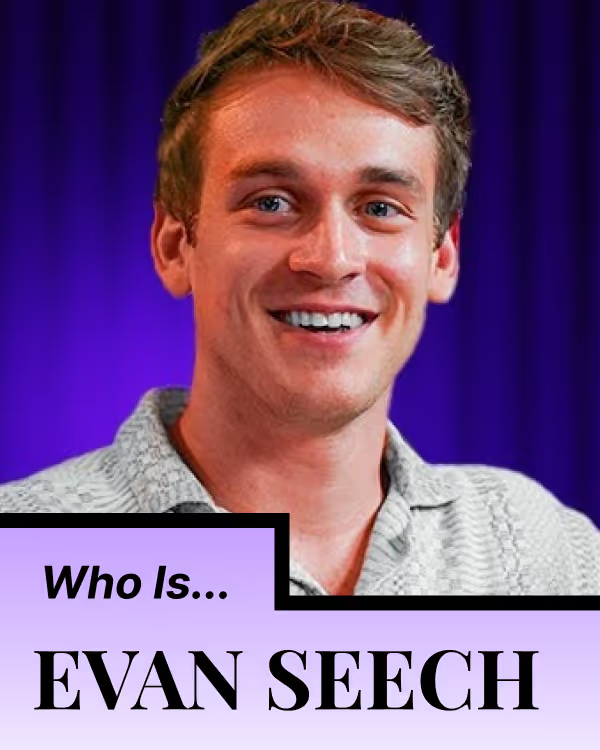
Evan Seech - Founder & CEO
Evan Seech is the founder of Sell More Online, a marketing agency that has generated over $47M in client revenue and manages $1.8M+ in monthly ad spend. He's known for building & scaling over 400 funnels for companies like Gym Launch, Bulls On Wall Street, Wojo Media, Home Invest, Moves Method, & Linq. Evan specializes in Meta ads, funnel building, and helping B2B companies, coaches, and agencies scale profitably without agency dependency.